Businessman Hands Gestures: Mastering Visual Communication in Design
In the fast-paced world of digital marketing and brand strategy, we often spend hours debating the perfect serif font for a header or the ideal kerning for a sans serif font body text. However, visual communication extends far beyond typography. When you are building a brand identity or creating social media graphics, the non-verbal cues you use are just as critical as the words you write. This is where the specific utility of Businessman Hands Gestures becomes an essential asset in your design assets library. It isn’t just a collection of images; it is a vocabulary of authority, direction, and connection.
The Visual Vocabulary of Authority
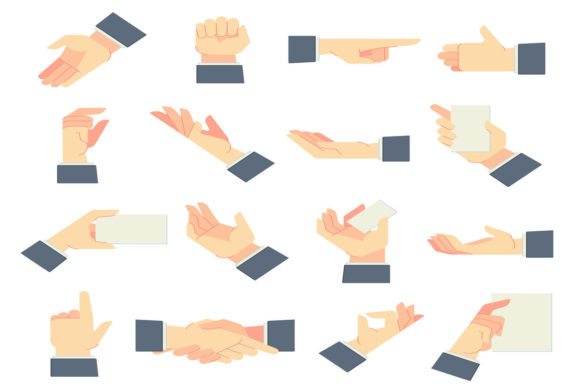
The specific product we are looking at—a high-resolution JPEG file featuring a Cartoon vector illustration style—offers a distinct aesthetic advantage. Unlike photorealistic stock images, which can often feel generic or clash with modern UI designs, these illustrations provide a clean, stylized look. The set includes a variety of essential motions: the direction pointing hand, the giving handful gesture, and the authoritative hold in male hands. These are not just random shapes; they are carefully crafted icons designed to convey specific psychological triggers.
Consider the direction pointing hand. In web design and editorial design, user attention is the most valuable currency. A pointing hand acts as a visual arrow, guiding the viewer’s eye exactly where you need it to go—whether that is a "Buy Now" button, a disclaimer, or a key piece of data in an infographic. The style of this illustration, being a vector illustration isolated icon, means it integrates seamlessly into minimalist layouts without overwhelming the core content.
Integrating Gestures into Modern Branding
When we talk about modern typography and design trends, we are often talking about clarity and impact. The "Man motion hand" and "businessman's thumbs" offer a way to inject personality into a layout without sacrificing professionalism. For the entrepreneur or small business owner, using these gestures in packaging design or logo design elements can soften the corporate tone. A stylized thumbs-up, for instance, acts as a universal symbol of approval and trust. It is a visual shorthand that says, "We've got this," or "Great job," bridging the gap between a faceless corporation and a human-centric brand.
Furthermore, the versatility of this file allows for creative manipulation. The prompt notes that the file is a JPEG, but the underlying style mimics vectors. For the designer or hobbyist who wants to separate elements or change colors, the recommendation to use a vector editor like Adobe Illustrator is crucial. This flexibility means you aren't stuck with a static image. You can match the skin tone to your brand palette or adjust the line weight to match your chosen display font. This level of customization ensures that your visual assets remain consistent with your overarching brand identity.
Practical Applications for Creators and Marketers
How do we actually use these assets in the wild? The applications are vast, spanning across different mediums and industries.
- Presentations and Pitch Decks: Instead of bullet points, use a giving handful gesture to represent "offering a solution" or "presenting data." It breaks the monotony of text-heavy slides.
- Blog Headers and Editorial Design: Content creators and bloggers can use these illustrations to break up long blocks of text. A pointing hand can highlight a "Key Takeaway" or a "Pro Tip," improving readability and visual hierarchy.
- Mobile App UI: In user interface design, hand gestures are often used in onboarding tutorials. These illustrations can guide new users on how to swipe, tap, or hold their device, making the experience feel more intuitive.
- Merchandise: For crafters, these isolated icons work beautifully on mugs, t-shirts, or tote bags. A cartoon "Hold in male hands" gesture holding a coffee cup or a lightbulb can create a relatable, humorous product for the corporate market.
Choosing the Right Asset for Your Project
As with choosing a premium font, selecting the right visual asset requires a critical eye. You need to evaluate the "personality" of the illustration. Does the cartoon style lean more towards corporate minimalism or playful pop-art? For a serious financial institution, you might want a more subdued line drawing. For a startup or a creative agency, the bolder, cartoonish style of this specific set might be the perfect fit to convey energy and approachability.
It is also worth considering the "hold in male hands" aspect of the description. While this specific asset focuses on male hands, the design principle remains universal: the hand represents the user. When using these in your marketing materials, ensure the context matches the gesture. A tight fist might represent struggle or strength, while an open palm represents transparency and offering. Aligning these visual cues with your messaging is a subtle but powerful way to influence brand perception.
Technical Considerations and Workflow
The product file provided is a JPEG at 4500x4500 pixels. This is a substantial resolution, suitable for high-quality print work as well as digital retina displays. However, there is a technical nuance here that professionals need to understand. JPEGs are raster files, meaning they are made of pixels. While the resolution is high, you cannot scale a JPEG up infinitely without losing quality.
If your project requires resizing the businessman hands gestures frequently—perhaps for a responsive website where the image size changes on mobile versus desktop—you may encounter artifacts. The best practice here, as noted in the file description, is to trace these elements in a vector editor. By converting the JPEG into a true vector path, you create a scalable asset that remains crisp at any size, from a billboard to a business card. This workflow ensures your design assets are future-proof.
Enhancing Visual Hierarchy
Finally, let's talk about how these gestures influence readability and engagement. In web design, we use scale and position to create hierarchy. Large text grabs attention first, followed by smaller text. Visual elements like these hand gestures act as "anchor points." A large, pointing hand placed next to a subscription form does more than just decorate the space; it psychologically pressures the viewer to look at that specific area. It creates a focal point that organizes the chaos of a webpage.
For marketers and publishers, this is a tool for conversion. By using a gesture that mimics a "stop" or "look here" motion, you can effectively pause the user's scroll. It adds a human element to the digital interface, reminding the viewer that there is a person behind the screen trying to communicate with them. Whether you are designing a newsletter, a landing page, or a social media ad, incorporating these specific, well-crafted gestures can significantly boost engagement and make your content feel more alive and interactive.